
10 Words to Cut From Your Romance Novel Right Now

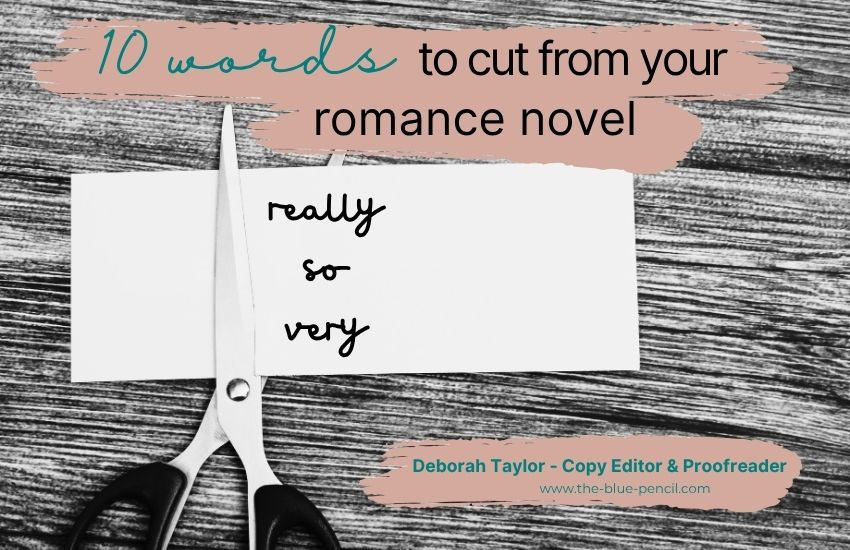
There's a small group of words that appear in almost every romance manuscript I work on. They're not wrong, exactly. They don't break any rules. But they quietly weaken your writing every single time they show up—and in a romance novel, where emotional impact is everything, that matters.
The good news? Cutting them is one of the fastest, most satisfying edits you can make. A find-and-replace session in MS Word with this list to hand could transform the confidence and pace of your writing in an afternoon.
Here are the ten culprits.
1. Just
She just wanted him to notice her. He just couldn't stop thinking about her.
"Just" is the verbal equivalent of a shrug. It minimises the very feelings you've worked hard to build. Remove it almost every time and watch your sentences stand taller.
2. Really
She really loved him. It was really beautiful.
"Really" is meant to intensify, but it does the opposite—it signals that the word it's modifying isn't doing its job. Find a stronger word instead. She loved him desperately. The view was breathtaking.
3. Very
The same problem as "really," and just as common. Mark Twain's advice still holds: substitute "damn" every time you're inclined to write "very." If it doesn't work, neither does "very." Cut it and upgrade the adjective. Very angry becomes enraged, very beautiful becomes gorgeous, very big becomes massive.
4. Suddenly
Suddenly, he turned. Suddenly, she felt her heart race.
"Suddenly" is supposed to create urgency, but it actually slows things down by announcing what's about to happen before it happens. Just make it happen. The pace will speak for itself.
5. That
This one is worth a dedicated search. In most sentences, "that" can simply be removed without any loss of meaning.
She knew that he was watching her. → She knew he was watching her.
Read back without it. Nine times out of ten, it's cleaner.
6. A little
Her heart hurt a little. She smiled a little.
In a romance novel, you want your reader fully in the emotion—not hovering at a cautious distance. "A little" hedges. It softens moments that are meant to land. Let them land.
7. Began to / Started to
He began to walk towards her. She started to cry.
Unless there's a specific reason the action was interrupted, just do the thing. He walked towards her. She cried. Cleaner, faster, more immediate.
8. Felt
She felt butterflies in her stomach. He felt his pulse quicken.
"Felt" creates a layer of distance between your reader and the character's experience. Push past the filter and put the reader directly in the moment. Butterflies flittered in her stomach. His pulse quickened.
9. Nodded / Smiled (as filler beats)
These aren't words to cut entirely—but if your characters are nodding and smiling their way through every other line of dialogue, it becomes invisible wallpaper. Vary your beats, and use them only when they're earning their place.
10. So (as an intensifier)
She was so angry. He was so handsome.
Like "very" and "really," "so" on its own doesn't intensify—it just points at the word and wishes it were stronger. Either cut it or write the scene in a way that shows you don't need it.
How to Use This List to Cut Words from Your Novel
Don't try to edit for all ten at once. Run a find-and-replace search in Word (or Google Docs) for each one, read the sentence in context, and decide whether it earns its place. Some will—but most won't.
A good rule of thumb: if the sentence means the same thing without the word, lose it.
Your words will be sharper, your characters more vivid, and your emotional beats will hit harder for it. Romance readers feel everything—make sure your writing does too.
Deborah Taylor is a copy editor and proofreader at The Blue Pencil, working with indie romance authors to bring out the best in their manuscripts. Got a project in mind? Let's talk.


Comments